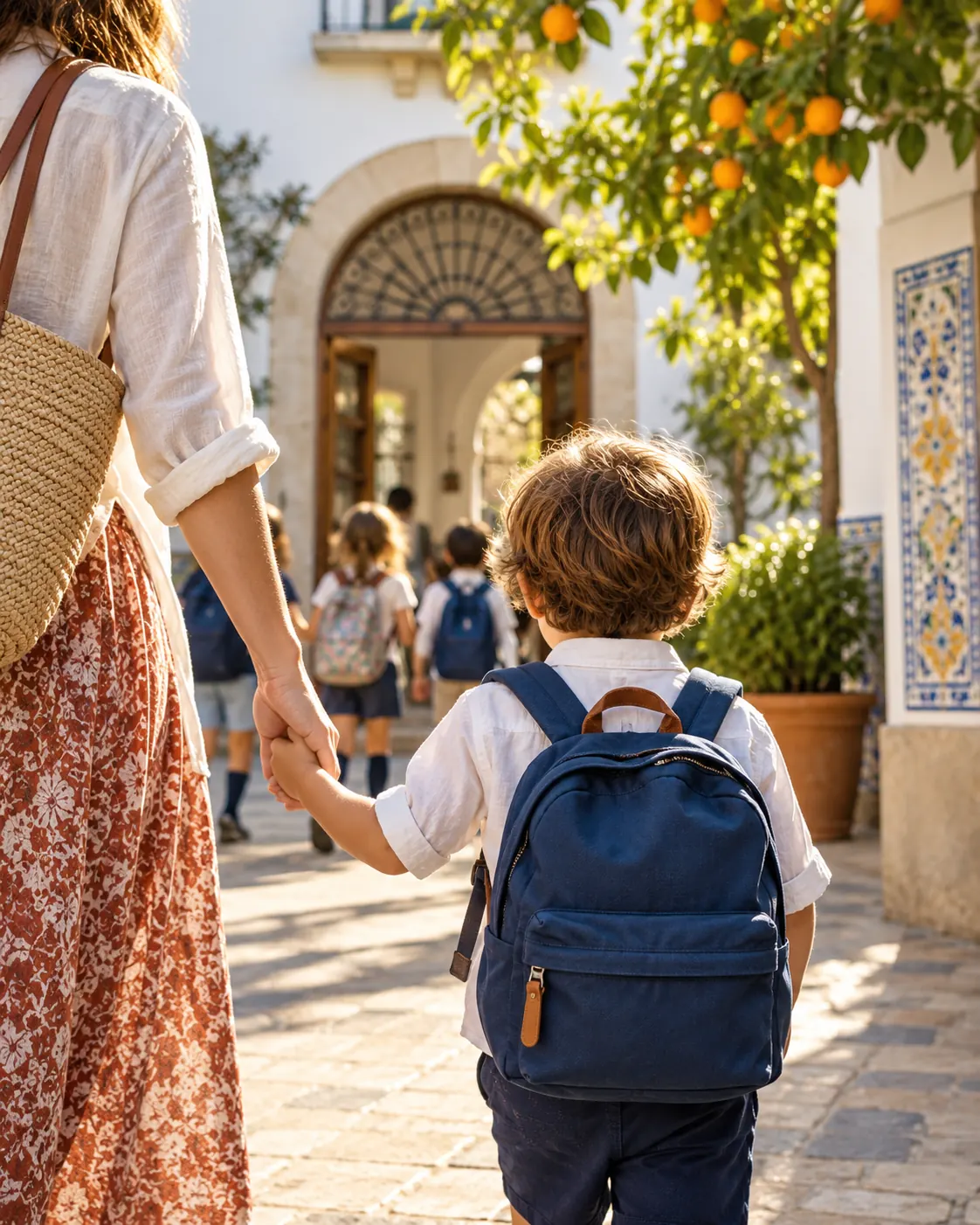
For families, the school decides almost everything else: the area, the commute, sometimes the moving date. The Spanish system is easy to understand once you know three things: children are grouped by calendar year of birth, public and concertado places are allocated by points in a single spring process, and there are two official languages in the Valencian Community. This guide covers Valencia city and its metropolitan area.
How the school system works
| Stage | Ages | Compulsory? | Good to know |
|---|---|---|---|
| Nursery (primer ciclo de infantil) | 0 to 3 | No | Nurseries (escoletes) and some public schools with a class for two-year-olds |
| Infant school (segundo ciclo de infantil) | 3 to 6 | No | Free in public and concertado schools. Almost every child attends, and it's where most children get a place for the rest of primary |
| Primary (Primaria) | 6 to 12 | Yes | Six years, in the same school as infant school in most cases |
| Secondary (ESO) | 12 to 16 | Yes | Four years, usually in a secondary school (instituto) or the same concertado school |
| Bachillerato or vocational training (FP) | 16 to 18 | No | Two years. Bachillerato leads to the university entrance exam |
Year groups follow the calendar year of birth (January to December), not a September cut-off. A child born in the autumn may land in a different year group from the one they'd be in at home. The school year runs from early September to late June.
Public, concertado, private and international
| Type | Cost | Admission | Good to know |
|---|---|---|---|
| Public | Free tuition. Lunch, after-school activities and some materials are paid | Regional online process, by points | Taught in Spanish and/or Valencian, with English. The regional textbook programme lends many books |
| Concertado (state-funded, privately run) | Free tuition; many ask for voluntary contributions and charge for services | Same process as public schools | Often religious. Popular ones fill up with siblings first |
| Private | Monthly fees | Direct with the school | Spanish curriculum, own ethos and timetable |
| International | Monthly fees plus enrolment and other charges | Direct with the school, waiting lists | British, American, IB, French or German curricula |
International schools around Valencia
The best-known include the British School of Valencia, Caxton College, Cambridge House, the American School of Valencia, El Plantío International School, Mas Camarena, the Lycée Français de Valence and the Deutsche Schule Valencia. Several are outside the city, in Puçol, Rocafort, Paterna or Bétera, and run school buses. Each has its own admissions, fees and waiting lists: ask for the current fee sheet, the curriculum it offers for your child's age and whether the bus covers your area.
How public and concertado places are allocated
The Conselleria de Educación runs one online admission process each spring for the following school year. Infant and primary usually go first, secondary and Bachillerato a few weeks later. The exact dates are published every year on the Conselleria's admission page: check them there, and don't trust dates copied from previous years.
The steps
- You submit one online application listing schools in order of preference.
- Each school ranks applicants by points (the baremo) if it has more applicants than places.
- Provisional lists are published, there's a short window for claims, then the final lists.
- You formalise enrolment at the assigned school within the deadline. If you don't, you lose the place.
What gives points
- Siblings already at the school, or parents working there.
- Proximity of your home (or, in some cases, a parent's workplace) to the school.
- Family income.
- Large-family or single-parent-family status, disability and other circumstances set out in the rules.
Ties are resolved by a public draw. Check the current area map for your municipality: in Valencia city the whole municipality has been treated as one area in recent processes, so where you live inside the city matters less than in many other towns. Outside the city, the address can make a real difference.
Address points need proof, usually the padrón. If you're still abroad in spring, plan the lease and the application together. This is the step where families most often lose a year.
Arriving mid-year
You can get a place outside the spring window. Families who arrive during the school year, or after the process has closed, apply through the schooling commission (comisión de escolarización) for their area. It assigns a place in a school with vacancies, which may not be your first choice. You can apply for a change in the next spring process.
What to bring
- Padrón certificate.
- Passports or NIE of the child and parents.
- Birth certificate or family book, apostilled and translated if needed.
- Latest school reports and vaccination record.
Children in primary are placed by age. For secondary and Bachillerato, foreign studies may need to be recognised (homologación) by the Ministry of Education. While it's being processed, the child can usually enrol provisionally with the receipt of the application. Ask the school what they need.
Spanish, Valencian and English
Spanish and Valencian are both official in the Valencian Community, and schools teach in both, with English as the main foreign language. Under the regional education law of 2024, families choose the base language of teaching (Spanish or Valencian) when they apply, within the options each school offers.
Pupils who arrive from outside the region or from abroad can request an exemption from assessment in Valencian for a period. The school explains how to request it at enrolment, and I help you do it.
Young children usually pick up both languages within a school year. For teenagers, a school with experience of newcomers, or an international school for the first years, can make the change easier.
Nurseries for 0 to 3
Nursery is optional. You have municipal nurseries (escoletes infantils municipals) with their own admission calendar, private nurseries, and some public schools with a class for two-year-olds. In recent years the Generalitat has funded free places for two-year-olds in many public schools and financial help for nursery fees. The conditions change, so ask for the current year's rules before you budget.
Carolina's tip. Choose the type of school before the area, then look for homes with an easy school run. Families who do it the other way round often find the perfect flat and then spend two years on a 40-minute drive every morning. For international schools, contact them as early as January: popular year groups fill up.
Official sources
- Conselleria de Educación: student admission, dates and rules (ceice.gva.es)
- Conselleria de Educación (ceice.gva.es)
- Ministry of Education: recognition of foreign studies (educacionfpydeportes.gob.es)
- Ajuntament de València: municipal nurseries and padrón (valencia.es)
Updated: October 2026. This guide is general information, not legal or tax advice. Rules and deadlines change: check the official source or ask me about your case.